 |
| Link: The Telegraph, ‘Holiday Money: The Ultimate Guide to Buying’ |
Showing posts with label international spelling variations. Show all posts
Showing posts with label international spelling variations. Show all posts
Tuesday, 12 April 2016
You Cannot Be Serious, # 64
The Telegraph hedging its spelling bets again:
bureaus; bureaux

Monday, 8 February 2016
Spellchecking Is Never Enough, # 218
Dr Faustus seems to have been doing some online competency tests, and finding various mangles. Today’s include an accidental substitute, some American spelling that seems to have crept onto the global company’s British website, a stray bit of code, and some rather dubious logic:
 |
| Source: CEB — SHL Talent Measurement |
Monday, 25 January 2016
Multimangle, # 37
Saluting the Scots poet for a second day with some more unfortunate spellings, although this time the apostrophe mangles are avoided as Burns is not mentioned :
 |
| Link: The Old Hand & Diamond Inn, Coedway |
Saturday, 23 January 2016

Friday, 10 July 2015
The Wrong Word Entirely, # 82
Dr Faustus has come upon this erroneous word before in formal literature on journalism courses. This version, on the right, comes with some clunky syntax and bad punctuation, on the left, and can be found in a study programme issued by The National Council for the Training of Journalists:
 |
| Link: NCTJ.com, ‘NQJ News Report – Programme of Study 2014-15’ |
Although the NCTJ is a British association, the document also uses practice as a verb throughout. It appears that at least some of the many mangles of British journalism are actually being taught…
Tuesday, 17 February 2015
The Wrong Word Entirely, # 71
I was invited to sign this petition some time ago:
 |
| Link: UK Government, e-petition, ‘Introduce mandatory noise complaint waivers […]’ |
The main mangle is innumerate for innumerable, which I’d not come upon before.
Note: the petition attained over 43,000 signatures. The government’s detailed response concludes that adequate legislation is in place to safeguard both venues and residents. The issue will be reconsidered should the number of petitioners reach 100,000.
innumerate for innumberable
Note: the petition attained over 43,000 signatures. The government’s detailed response concludes that adequate legislation is in place to safeguard both venues and residents. The issue will be reconsidered should the number of petitioners reach 100,000.
innumerate for innumberable
Saturday, 3 January 2015
Double-take, # 123
This mangle is surprisingly widespread and comes in at least these two variants, but there may be more. The first example is the more common error:
 |
| Link: NorthPole.com, Craft Cottage, ‘Poke a Dot Luminaries’ |
The second is less common, but not hard to find:
 |
| Link: Volcom.com, ‘Poker Dot Gloves’ |
The Oxford English Dictionary shows a pronunciation difference between UK- and US-English:

Spelling errors are thus more likely to be American. The term must, of course, be taught. If the l is not sounded, the correct spelling cannot be deduced from the sound; nor can it be inferred through logic, for, as the Online Etymology Dictionary points out, the connection between polka dots and the polka is arbitrary: the dance was popular and it became fashionable to append the name randomly.
An American company produces a series of ‘Poke-a-Dot’ books, intended to teach counting to young children:
The series title is a great pun; but a pun can be fun and effective only if it is understood as a pun. In practice, this series title is likely to consolidate the misspelling, and it is not impossible that the title is itself based on a misunderstanding of the term.
poke-a-dot; poker dot
An American company produces a series of ‘Poke-a-Dot’ books, intended to teach counting to young children:
 |
| Link: InnovativeKids, Our Products, ‘Poke-A-Dot’ |
The series title is a great pun; but a pun can be fun and effective only if it is understood as a pun. In practice, this series title is likely to consolidate the misspelling, and it is not impossible that the title is itself based on a misunderstanding of the term.
Tuesday, 14 October 2014
Spellchecking Is Never Enough, # 149
This extract contains a typographical error resulting in a very odd concept, and a spelling choice that suggests that Ilford has been relocated to the USA:
 |
| Link: Ilford Recorder, ‘Forest Gate Couple on Pedal-power Charity Trip to Paris’ |
The idea of vaccinating against polo is amusing here, but the error would be heinous in the context of a tragedy. The recasting of foetal (with the oe representing the ligature œ, as in fœtal) to fetal is puzzling; both Cambridge Dictionaries Online (CDO) and Merriam Webster, for instance, distinguish the spellings as British and North American variants respectively. Against the logic that suggests fetal should rhyme with metal and petal, CDO offers audio pronunciation guides in which both variants sound the first syllable as a long ‘e’. Yet altering a ligature to a plain vowel sometimes results in a shift in pronunciation, both visually and aurally distancing the word from its etymology. One example is paedophile, which in the USA is spelt pedophile and pronounced in its first syllable to rhyme with fed, not with feed.
polo for polio; fetal for foetal
Thursday, 11 September 2014
Double-take, # 97
Dr Faustus submitted this mangle —
 |
| Link: The Past Speaks blog, ‘Perspectives on the Evolution of States, Markets, and Economic Culture’ |
— with the comment: ‘Well, is it or isn’t it?’ It’s a fair point and I think we should be plainly told.
Two sentences later, I was surprised to learn that the length of the US states is relevant in politics…
Since the entry has been provided specifically ‘for the benefit of […] Canadian readers’, perhaps the term ‘blank cheque’, with its UK spelling, isn’t the most helpful analogy. Or is it?
is isn’t; written constitutions, unlike US states, some of which are very lengthy; ‘blank cheque’ [for Canadian readers?]
Tuesday, 9 September 2014
Double-take, # 96

The subheading failed to improve matters — rather the reverse, in fact:

As Des says: ‘What does “anniversary” mean?’ Someone at the Beeb noticed or was told, as both mangles had been corrected by 9.35am, but they should never have been there at all.
six-month anniversary
Monday, 25 August 2014
Double-take, # 92

Since ‘a day’ relates to time, not place, to use where in this context is completely illogical.
The word child is grammatically both singular and neuter (cf. baby), biologically sexually unspecific and culturally non-gender-specific; it would thus be more correct and more logical to use the pronoun its to represent the noun. If it were being applied to a particular child in a particular context, it could be sexed accordingly. If the noun were made plural, their would make greater sense and be more grammatically sound; it might also increase the the statement’s emphasis. As it is, it reads rather as if their was agreeing in number with parents rather than child.
a day where; no child … their
The word child is grammatically both singular and neuter (cf. baby), biologically sexually unspecific and culturally non-gender-specific; it would thus be more correct and more logical to use the pronoun its to represent the noun. If it were being applied to a particular child in a particular context, it could be sexed accordingly. If the noun were made plural, their would make greater sense and be more grammatically sound; it might also increase the the statement’s emphasis. As it is, it reads rather as if their was agreeing in number with parents rather than child.
Tuesday, 19 August 2014
Double-take, # 89
This is a section of an advertisement that runs regularly in the Rugby Observer:
 |
| Link: Rugby Observer, 7 August 2014, p. 2 |
As an aside, I’ve noticed only recently that the publication has dropped the direct article from its masthead, although I’m almost positive that it used to be shown. The website’s address includes it, and the copyright details also show ‘The Rugby Observer’. The potential broad application of the noun seems to require greater specificity, and it’s certainly customary.
up to a huge £75 minimum
Friday, 6 June 2014
Spellchecking Is Never Enough, # 130

Another oddity from the inbox of Dr Faustus, who wanders [sic]: ‘Is a last night party male?!’
male party? wonders for wanders
Thursday, 10 October 2013
How much and how many?
A forwarded message in my inbox, with the subject line: ‘Dr Faustus says: Someone doesn’t realise that you can count people...’ Here (edited slightly) is the offending email:

Dr Faustus commented: ‘Fewer than 18 students! Fewer than! /rage.’*
* The OxfordDictionaries page ‘“Less” or “fewer”?’ explains how to tell when to use less and when to use fewer. I’d also point out that the correct UK-English spelling is enrolment, and the use of the hyphen (presumably meant to represent a dash) is erroneous, since the ‘Many thanks’ clause and the passage beginning ‘unfortunately’ do not share a subject and should be separate sentences.
Monday, 7 October 2013
Double-take, # 22
Something has gone wrong with the deletion in this magazine advertisement for Marisota clothing:

Surely only the don’t should be crossed out for the tagline to make sense…
Monday, 16 September 2013
Apostrophe catastrophe, # 19
Why?

Why apostrophize just one? Why pluralize some and not others? Aaargh!

Why apostrophize just one? Why pluralize some and not others? Aaargh!
Tuesday, 16 April 2013
Mangling Meaning, # 4
There's been much mangling of meaning by the media recently. Today's almost indecipherable example, which combines general balderdash with syntactically unviable quotations and some USA spelling, comes from last Sunday's online Telegraph:

Sunday, 17 February 2013
Mangling Meaning, # 3
This
is from the Android edition; both headline and text were also
originally online, but have been changed on the main BBC News website…
Still available on several other pages, though, such as 5Live.
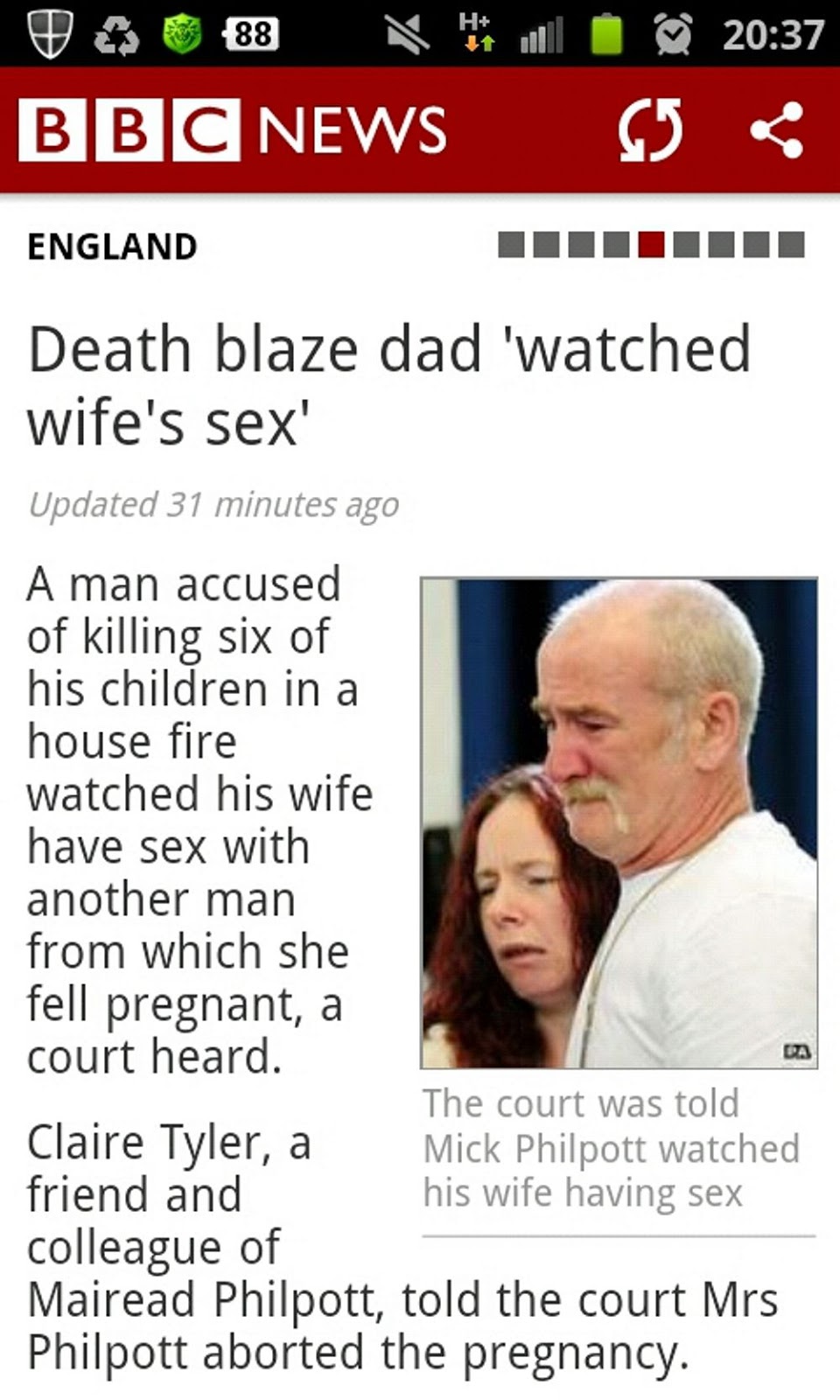
The first paragraph soon loses its connexion to comprehensible prose, while the screamer is ambiguous to the extent of provoking inappropriate humour. Indeed, the headline seems more suited to the tabloid media: is the BBC repositioning itself?
Saturday, 16 February 2013
Mangling Meaning, # 2
The Rugby & Lutterworth Observer seems not to understand the point:

If horse were 'on the menu', it wouldn't be a problem: it's not illegal and eating it would be an active choice. The issue is, in fact, exactly that it's not listed 'on the menu',* so no-one was aware it was in the food on offer — and that is illegal.
* Definition of 'menu' from the Oxford English Dictionary:
II. Senses relating to a list or schedule. 2. a.
A list of the dishes to be served at a meal, or which are available in
a restaurant, etc.; a card on which such a list is written or printed, a
bill of fare. Also: the food available or to be served at a meal or in a
restaurant.
Friday, 8 February 2013
Mangling Meaning, # 1
Headlines seem to have become more idiotic than ever. These are variations on a theme that featured across much of the UK media yesterday:


(Android edition)
Most of the offenders made matters plain (100% of the meat content) in the subheadings, but some simply compounded the idiocy:

4News abandoned the percentages altogether:

Since
the product in question was supposed to be lasagne, you'd have thought someone would
have noticed the lack of pasta, cheese and tomatoes a lot sooner.
Subscribe to:
Posts (Atom)